There’s nothing quite like seeing years of collaboration, science, technical expertise and sheer grit come together to create something that can genuinely make the world a better place.
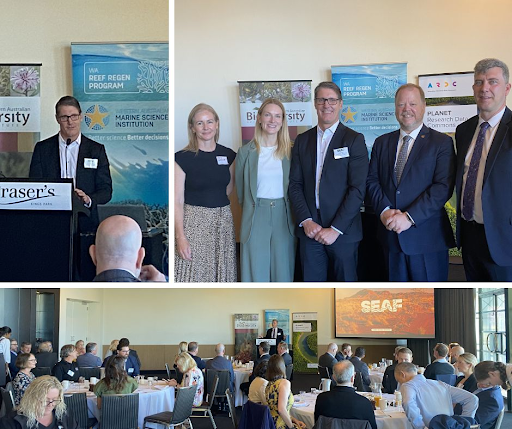
Recently, our friends at the Western Australian Biodiversity Science Institute (WABSI) officially launched the pilot phase of the Pilbara Spoke of the Shared Environmental Analytics Facility (SEAF). Here at Gaia Resources, we’ve been proud to support the technology build and implementation to help make this idea a reality, and we participated in the launch over breakfast at Frasers Restaurant in Kings Park along with other scientific and technical experts, surrounded by stakeholders and industry representatives who have stepped up as joint participants of this solution and topped off with speeches from the Ministers for Science (Stephen Dawson) and Environment (Matthew Swinbourn).
Historically, private companies interacting with the environment in the Pilbara (such as mining companies) would amass volumes of biodiversity data from their operations (right across the exploration, assessment, operations and closure stages). This biodiversity data would sit in a silo within the organisation and not be shared more widely - apart from subsets of it being submitted as part of the environmental impact assessment or licencing processes. This stopped the opportunity for amassing a more complete understanding of biodiversity across the wider Pilbara from all the participants in the region.
The core mission of SEAF is to mobilise this biodiversity data and stitch it into a more thorough understanding through various complex, scientifically robust analyses, without disclosing proprietary data from any of the participants. You can think of it as building a critical part of a trusted environmental data supply chain - which has been a focus of our work since the Samuel review in 2021 with projects such as our work with Dandjoo in WA and the Biodiversity Data Repository for DCCEEW. SEAF takes raw biodiversity data from the participants, utilises scientifically robust analyses such as distribution models to process the data, and spits out practical outputs like datasets and maps that the participants can use, all while respecting the privacy of the entities involved.
Our role? We’re the interface between the science and the operations of SEAF. Gaia Resources has led the design and development of the Pilbara Biodiversity Spoke, focusing heavily on operationalising the incredible science that others create. We do this through the approach of undertaking proof of concept rapid proof of concepts, determining what scientific research could support the problem (and what exists already) and then operationalising the science that exists within the SEAF environment.
Six Areas Making an Immediate Impact
While there’s a long term roadmap to come, during the pilot phase we focused our attention on six key areas that were seen as useful by the initial participants. Right now, the SEAF Pilbara Biodiversity Spoke is delivering tools in the areas of:
- Data ingestion - ensuring that the participants can deliver the data to the SEAF platform simply and easily without a need for major rework of their existing data structures and standards,
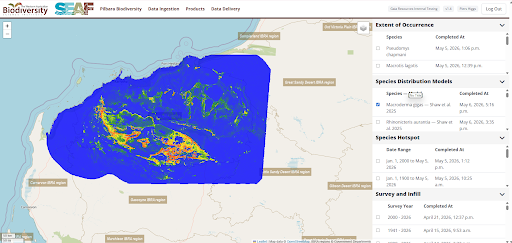
- Extent of Occurrence (EoO) analysis - undertaking a basic “join the dots” around the records of the species in question, showing the known distribution of the species in a very simple manner - which can be done for any species that there has been data provided on,
- Species Distribution Modelling (SDM) - implementing scientifically robust and published methods for some of the key species of the Pilbara, including the Northern Quoll (Dasyurus hallucatus), Pilbara Leaf Nosed Bat (Rhinonicteris aurantia), Ghost Bat (Macroderma gigas) and Greater Bilby (Macrotis lagotis) - all of which we were only able to do only through the support from researchers at organisations like the Department of Biodiversity, Conservation and Attractions
- Species diversity hotspot analysis - combining all the data in the Pilbara Biodiversity Spoke to determine the areas where the most species are recorded, and
- Survey effort tracking - to provide some context for the previous tool, we need to be able to also know which areas have been surveyed more heavily than others, so that we can start to investigate survey effort bias in the data, and
- Data delivery - making sure that the products in the system can be brought back out as images, maps and datasets that can be used by the participants in their own systems for further investigation.
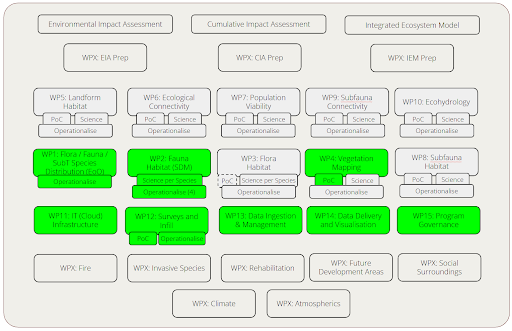
During the pilot we also undertook some other proof of concept work in areas such as Vegetation Mapping - which showed that there was a need for more work to be done in these areas, and so that has been fed into the proposals for the Pilbara Science Plan that WABSI is also developing as part of their work.
Looking Over the Horizon
This is just the beginning for the Pilbara Biodiversity Spoke. Working alongside WABSI and the project participants has been a truly exciting opportunity, and collaboratively we're already looking at what’s next on the horizon through the longer term roadmap that we helped create during the project.
Future phases are set to tackle even bigger systemic challenges, creating supporting tools to assist in Environmental Impact Assessment, Cumulative Impact Assessments and Integrated Ecosystem Models. This means bringing together everything from climate data to atmospheric tracking into one holistic view of the Pilbara environmental and goes much further than just the biodiversity aspects that were covered in the Pilot phase, which we’re really excited about. Australia is a big country and the learnings and technologies could definitely empower better decision making and investments in the environment across the country with the right participants.
We want to say a massive thank you to WABSI and all the industry partners involved. It’s a privilege to build the digital infrastructure that protects our unique and beautiful backyard. For more information on the Pilbara Biodiversity Spoke feel free to get in touch with WABSI via their contact details or reach out to us at Gaia Resources on (08) 92277309 or via [email protected].
Piers