Travelling for a conference is always an outsized experience. New places, new people, new connections, new directions, so much input! So it was with much excitement that I travelled to Wellington, New Zealand recently for the DrupalSouth 2026 conference.
Drupal, as the largest open source enterprise-capable CMS in the world, has always been driven by a large community. The spirit and drive of that community is often hidden from the casual observer, or from someone who simply downloads the Drupal Core, installs it and says "ok, what's next?". That experience has been one of the bugbears of Drupal and is thought of as a barrier to entry. But this experience has recently changed! More on that soon.
Community Day
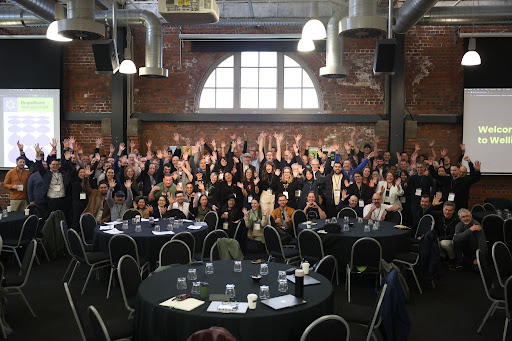
The first day of the conference experience is always Community Day, where anyone attending the conference can come along and is encouraged to join in and contribute to improving Drupal Core, modules, or any other part of the ecosystem. People collaborate to test, explore and fix issues, write documentation, build themes, work on side projects adjacent to Drupal, and learn from each other. There are always several "core contributors" (people who are responsible for merging pull requests and releasing new versions of Drupal Core) in attendance, especially as the Australia & New Zealand region is the largest per capita contributor to Drupal. Often there's friendly rivalry to find old issues to fix, or find new features to implement.
Drupal CMS
A major theme of the conference was driven by new developments in Drupal and how the platform is changing. "Drupal CMS" was first announced as an initiative in 2024. It is a packaged, product-like, curated Drupal setup that really does provide a ready-to-use CMS experience in just a few steps. It has since had a large group of people worldwide working to improve it, as demonstrated by the smooth experience of the recent version 2.0 release from a few months ago. There is no locked-in experience either, Drupal CMS uses all the elements of the standard Drupal ecosystem, adds some very useful new ones, still allows complete customisation, and showcases a growing ecosystem of community themes and recipes that are tailored to many different types of sites. After presentations by Pamela Barone and Owen Lansbury there was a real buzz in the corridors and sessions around the expanded possibilities afforded by Drupal CMS.
LLMs, agents, "AI", but it's still people driving Drupal
The "AI" conversation at Drupal conferences is unavoidable now, but what I noticed was the consistent framing around it - the importance of people was always present. "AI" is seen as a useful tool, a force multiplier for driving change. As Alex Skrypnyk said in his presentation:
[AI] does not remove engineering. It removes the friction around engineering ... Writing the code is no longer the hard part. Knowing what to write is.
Other presentations explored how you might need to adjust the content of your site for "the agentic web" - agents as consumers of your information, both in a positive way as people use them for searching, and in dealing with LLM or bot scraping traffic overload.
Government usage continues to evolve and innovate
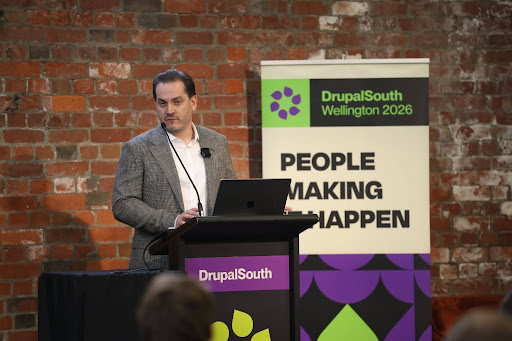
One of my favourite presentations was given by Jason Kiss, a web accessibility advisor from the New Zealand Government, who is part of a team that has built an open source accessibility testing tool called CWAC, which scans a set of NZ Government websites and publishes the results as open data across a series of dashboards. The tool itself is simple and focused, but what I was impressed by was that the data sharing aspect has caused departments to compete to improve their site accessibility - creating a "gamification" effect that has had real results in improving usability and accessibility for all their users, and will ripple out across the NZ Government. Australia needs something like this.
The Splash Awards
The evening of Day 1 closed with the Splash Awards ceremony at Shed 22, a peer-judged celebration of the best Drupal work across Australia and New Zealand. Alongside the project awards, the Ironstar Community Recognition Awards put the spotlight squarely on people. Lee Rowlands (larowlan) was inducted into the Hall of Fame - a recognition of years of prolific contribution to Drupal core that quietly underpins a great deal of what the rest of us build on. The People's Choice Award went to Adam Bramley and Nicole Ritchie - a nice balance of technical expertise and community contributions.
Conclusion
Drupal’s future is not just about new features. It is about making the power of Drupal easier to reach, while keeping the community spirit that made it worth using in the first place. After three days of talks about technical solutions, AI, the evolving Drupal platform, user experience, and government tooling, this is the thing that stuck with me. The ecosystem works because the community is real, and this conference was a reminder that open source is part technology, part community, and part stubborn optimism.
I saw this Māori proverb on the wall of a shop in Wellington the day after the conference, and it seemed a great summation:
He aha te mea nui o te ao? Māku e kī atu, he tāngata, he tāngata, he tāngata.
What is the most important thing in the world? Well, let me tell you, it is people, it is people, it is people.
Drew