Gaia Resources has been supporting the Western Australian branch of the Australian Society of Archivists’ Professional Development days for quite a few years:
- As part of the event in 2023, we presented on digital preservation, with both a “big” and a “small” case study (which has morphed into our Duct Tape and Downloads training over time),
- In 2024, we presented on AI and the implications for archival methods and some case studies, and
- In 2025, our focus was on choosing archival management systems.
This year we presented on the technological challenges and opportunities coming with the Records in Contexts standard. The day also featured talks from Adrian Cunningham (on Records in Contexts), Elizabeth Hawkins (from Queensland State Archives, who talked about our work implementing ArchivesSpace there), and from Damian Shepherd (State Records Office of Western Australia, who presented on the workplan for the Office moving forwards).
As mentioned, our presentation (linked below) was focused on the technology implementation considerations for the Records in Contexts standards.
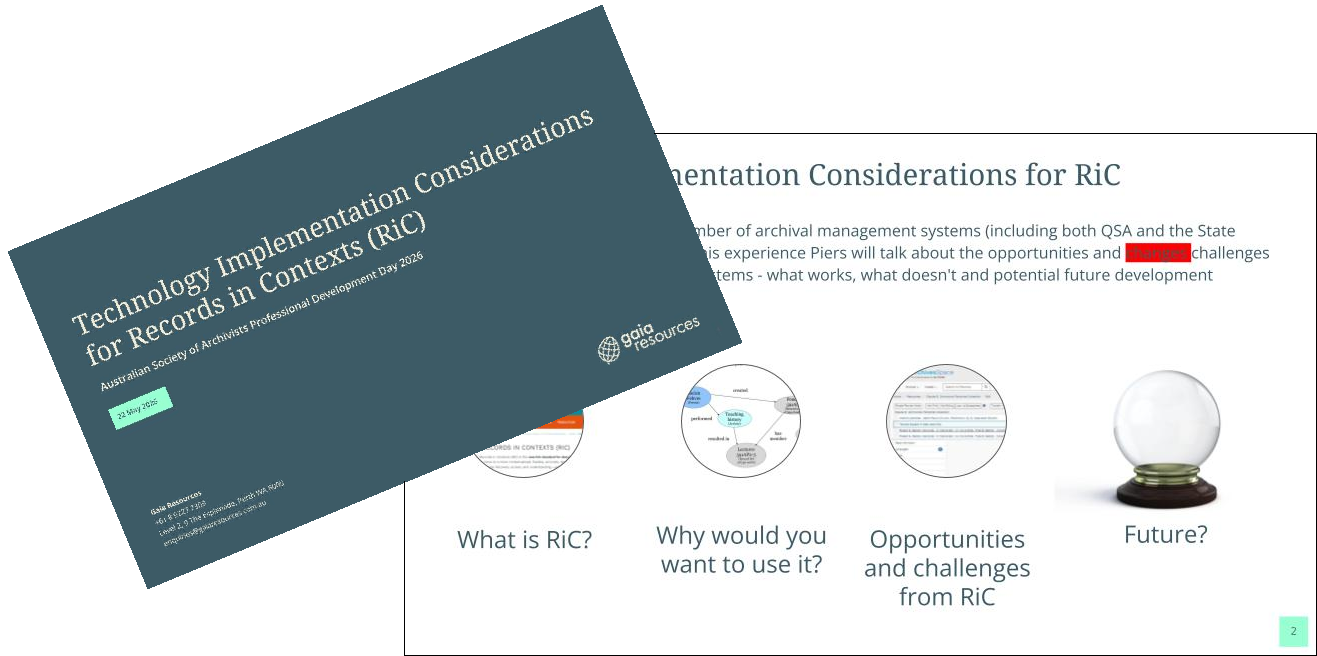
As part of this we covered a range of topics;
- What is Records in Contexts (RiC) - a high level review of the Foundations, Conceptual Model, Ontology and Application Guidelines for RiC, but with a technical focus,
- Why would you want to use it? - a quick repeat of some of the key points from the RiC Application Guidelines,
- Opportunities and challenges from RiC - a review of some of the opportunities, including multiple instantiations of archival records, linkages between datasets, Artificial Intelligence readiness, as well as some of the challenges that will be faced (more on that in a second), and
- Future? - what RiC means for both our data and our systems.
The challenges for RiC are things we have already lived over the past few years in working with our federal Environment department implementing a new graph-based data standard, and technologies to support that, under the Biodiversity Data Repository project. The challenges faced there - new technology stacks, data suppliers that don’t have the means to switch to graph based tech, new data standards that are highly extensible - and open to very different interpretations - were all things we could bring to the table for future RiC implementations. In the end, RiC presents a lot of opportunities, but there are some significant challenges we can learn from and move forward with, and hopefully we’ll be able to do this into the future.
There’s some real interest in how this will play out from us and so some of our future projects and internal research will be looking at this - let us know if you’re interested in RiC as well, because we’d love to have some people to collaborate with in this space!
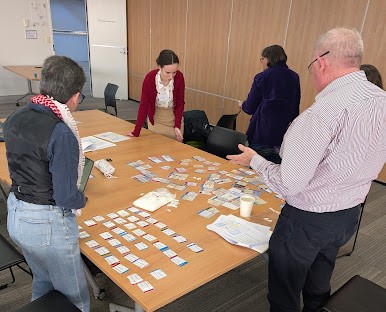
We finished the talks with a short panel session that Piers took part in, and then we had an interesting afternoon with a low-tech and very useful “card game” for RiC. In this “game”, we took a bunch of components of the RiC conceptual model, and connected them using relationship cards, paperclips (the approved archival ones, of course) and string. It was a really physical - and very useful - way to understand how much flexibility and depth there is in RiC - and the challenges of implementing it.
The ASA continues to offer these sorts of professional development days to their membership around Australia, and it’s something we’re happy to contribute to as a way of giving back to the community that has welcomed us with open arms.
For more information on RiC, or archiving systems in general, get in touch by contacting us at [email protected], contact me directly on [email protected], or feel free to give us a call on (08) 9227 7309.
Piers