When we talk about sustainability and environmental impacts, there are numerous factors to consider: power use, water use, biodiversity impacts and a range of other factors. Many of these are near and dear to our hearts here at Gaia Resources, as much of our work has an environmental focus. While each of these elements is important when assessing your own impacts, today we are starting our investigations into carbon emissions in the context of a collecting institution.
The idea of carbon emissions and carbon offsets has become ubiquitous - when you buy a plane ticket, you have the option to purchase carbon offsets, or when you review a utility bill, the calculation of your carbon expenditure is included. Carbon has become one of the most visible elements in climate change discussions, and it’s becoming a way that a range of industries measure their environmental impact, not to mention, it’s an entire industry in itself.
Carbon impact was a hot topic at this year’s JTS conference in Canberra. One of our main takeaways was “everything comes at a cost”, including a carbon cost. When the National Archives of Malaysia asked us to attend SEAPAVAA earlier this year in June to deliver our Duct Tape and Downloads training, we also were asked to incorporate a section to start working through carbon costs in digital preservation. To do so, our collections analysts worked with our data scientists to build two comparable scenarios and calculate the respective carbon costs, and we focused on Scope 1 (direct) and 2 (indirect from energy) emissions under the GreenHouse Gas (GHG) Protocol.
The scenarios we used were:
Scenario 1: A modern digital workflow for digital accessibility while keeping the original physical records as a "Dark Archive." We’re basing this use case on 100,000 A4 pages that, in this scenario, are digitised. These records will have gone through a digital preservation workflow once. The digital footprint included is 3.5TB of storage.
Scenario 2: Maintains a traditional physical access model. This does not include the storage and maintenance of any digital records. Again, these numbers are based on an archive of 100,000 A4 pages.
There are two key differences we see between Scenario 1 (digital) and Scenario 2 (physical): namely, the method of storage of the original paper records and the way that people would access the records.
When managing a digital archive, it’s important to note that we don’t want to remove or destroy the original physical records. As we have all experienced, hard drives fail, things happen and having a physical record is a risk-mitigation factor. That said, the temperature and humidity requirements for physical record storage typically consider human comfort as well. There is a smaller energy requirement when storing records that are accessed infrequently compared to records that are actively being used. This shift significantly cuts the carbon footprint of physical storage.
The second difference is the way in which researchers can access the records. A digital archive allows researchers to view records without requiring travel - a traditional paper archive does not have this option, as they would have to travel to the archive in order to view the physical copies on site. Technically speaking this would be a Scope 3 emission under the GHG Protocol, but it’s a carbon cost that doesn’t exist at all for the first scenario, so it’s worthy of consideration.
These two scenarios enable us to look at what carbon costs exist for digital file processing, storage, and access - all key points in the digital archiving life cycle. The examples are meant as a starting point, providing a baseline for further calculations. Our initial calculations for both scenarios are summarised in the table below.
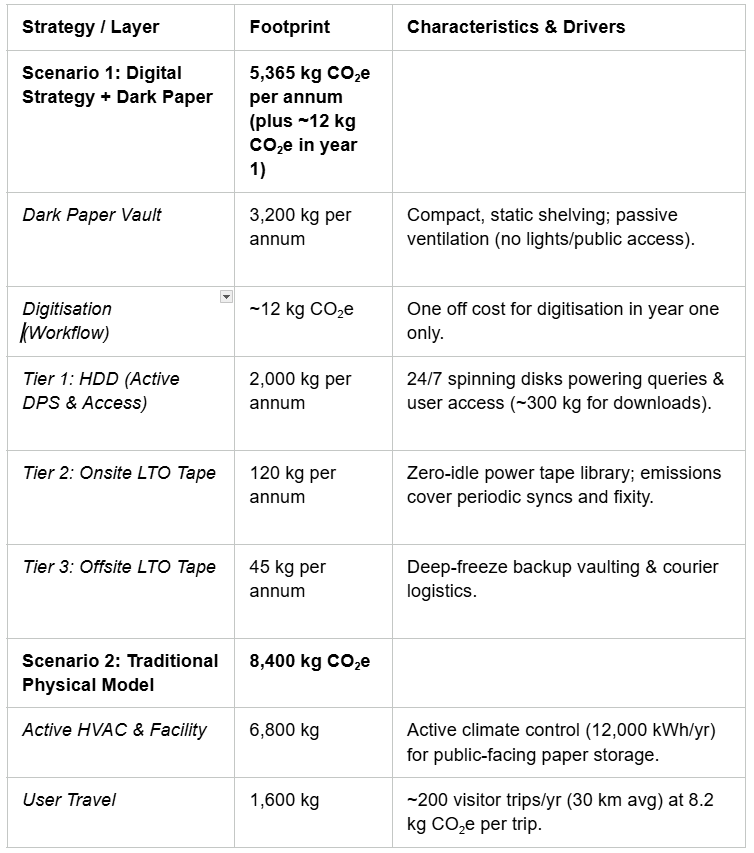
As a note on our workings, these estimates combine enterprise hardware specs, building energy standards, and clean-grid carbon metrics scaled to a 100,000-page (~3.5 TB) archive. For the digital infrastructure, we referenced enterprise server and LTO tape energy usage and data centre cooling overheads. We looked at commercial HVAC baselines for climate-controlled paper stores. There’s a lot more we could do with this, especially working with some of our partners and colleagues in this environmental accounting area. It’s an area that’s evolving rapidly, and it’s of real interest to us at Gaia Resources.
With these relatively simplistic costs in hand, we can do some comparisons. Looking at Scenario 1, the digital collection, over five years there would be an initial spike in resource use as digitisation efforts are underway, but thereafter the carbon costs decrease for those 100,000 records. However, for Scenario 2, maintaining an active store of physical paper where any access requires in-person visits, there is a constant higher expenditure of carbon. This is illustrated in the diagram shown below.
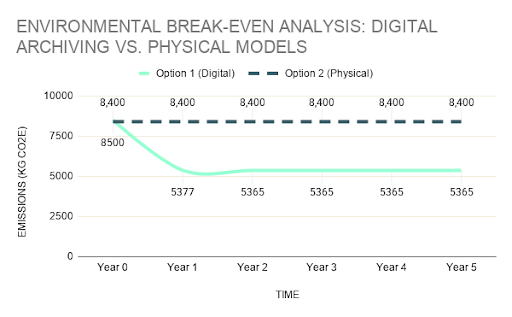
Perhaps contrary to current perceptions, a digital archive has the potential to be a more carbon friendly option. But of course, as with most things these days, it depends on a wide range of factors. The scenarios outlined above are just a starting point, and there are always other considerations to take into account, as well as the specific parameters around each digital and physical archive. There’s much more we can do in this area, but this simple analysis is something we hope sparks more discussion about the environmental cost of archiving.
While we look at our workflows and wonder what we can do to reduce our carbon costs, there’s one area that will remain a key factor in the carbon costs of an archive: appraisal. Having a discerning eye as to which records have long-term value - and which do not - has a direct impact on how much you have to digitise, how much you have to store and the respective carbon required for keeping a record for perpetuity. The development of clear collecting guidelines (and then adhering to them) can assist your archive in minimising unnecessary carbon expenditure and thus lessening your environmental impact.
In wrapping up the section about sustainability in our Duct Tape and Downloads training, we left participants with the message that while digital preservation is a small portion of carbon emissions in an archive, every step you take to minimise your impact is important. I will wrap up this blog with the same set of questions and considerations:
- Do the companies you engage with have a sustainability statement?
- Where does your power come from?
- Do you need to drive, or is public transportation an option?
- Can you recycle your out-of-date technology?
- What environmental choices and changes can we all make in our everyday lives?
We’re keen to hear about how others have approached this challenge. Have you calculated your own carbon emissions for all or part of your workflow? Tell us about it on our socials (Facebook, Linkedin and Instagram) or reach out via email.
Sarah
(in collaboration with Gail and Tyler)