Jarrad’s note: We hand the blog over to Mieke this time who was looking at how much of her work - including a lot of it at Gaia Resources - has involved the Atlas of Living Australia (ALA). This is her exploration of her journey with the ALA:
----------------------------------------------------------------------------------------------------------------
Twenty years ago I had just started my PhD in a very niche area (as most PhDs are…): the taxonomy of a microscopic group of fish parasites. Why you may ask??? Well, several reasons really. From a scientific perspective, the study of disease brings together so many interfaces of biology that there are so many angles to explore and get curious about. The fellow scientists in this area were really fun and then there were the field trips to the Great Barrier Reef which were the cherry on top.
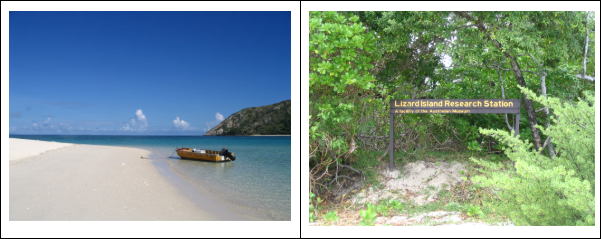
But one of the trickiest parts of kicking off my PhD back then was gathering the data on what was known about my parasite group of interest. I spent a lot of time searching many different databases and requesting journal articles from libraries etc. But little did I know that at the same time I was starting my PhD, so was the project to create an Australia wide biodiversity database, what we now know of as The Atlas of Living Australia (ALA). I didn’t know at the time but the Gaia Resources team was there in Canberra, with Piers involved leading the development of citizen science capabilities at the ALA.
My first experience of the ALA was during my first proper postdoctoral position in 2011 at the Western Australian Museum where we started sending our specimen record data to the recently launched ALA. Sharing data was one thing, but when I learned what it was like to be a user of the ALA data this was a complete game changer! All the biodiversity records, from all the Australian institutions and state repositories, all in one place!! And maps, glorious maps! The ALA certainly boosted productivity in biodiversity research with its accessibility to data.
I did not expect that when I transitioned to a job in technology, that I would have a lot to do with the ALA, but because of the biodiversity and environmental specialisation of Gaia Resources, it was inevitable. The ALA is now our go to for accessing the broadest source of biodiversity data in Australia, providing many ways to interact and extract the data. As such, we feature the ALA as an external data resource to enhance the Extent of Occurrence and Species Distribution Modelling features in projects like the Shared Environmental Analytics Facility platform we recently posted about. I could go on and on about the features of ALA, but perhaps you could check them out yourself if you like at https://www.ala.org.au/sites-and-services/
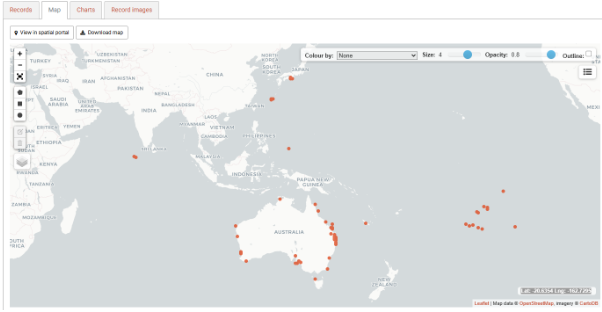
Our company has had quite a few collaborations with the ALA over the years. I have been lucky to be involved in two of them recently. In 2024, I was honoured to go full circle back to my PhD roots where we were a co-recipient of a Biodiversity Data Mobilisation Grant with the Queensland Museum to digitise the data from one of my PhD supervisors: Associate Professor Thomas Cribb. Not only did the grant facilitate us publishing 40 years of collecting records from Tom’s lab, which included 20,510 fish host records and 18,064 parasite records; but it allowed us to transform the Queensland Museum’s database to record and publish the relationships between individual organisms. In this case, the relationships between the parasites and their hosts. This dramatically expands the ecological inferences that can be made from data shared from the Queensland Museum.
Fast forward to this year and, in collaboration with some of the staff at the ALA and a worldwide task group, I am involved with the ALA again. Gaia Resources are giving back to our community with our involvement in proposing an extension to the Darwin Core biodiversity data standard to cover handling of what is termed Restricted Access Species Data. It covers scenarios where data associated with biodiversity/ecology records are made less precise or are withheld from certain audiences to protect the organisms, the environment, or people and their privacy. This extension will provide a framework for data providers to be able to share data with the comfort in knowing that those who need to know the full data know that the data exists and how they access it as well as offering the security of being able to protect the data that needs protecting.
The ALA are always enhancing their features to increase capacity in biodiversity data collection, management, publishing, accessing, and interpreting. You can read more on the history of the ALA from 2006 to 2021 here: https://doi.org/10.3897/BDJ.9.e65023 and what they are up to right now via their https://www.ala.org.au/blog/.
The ALA has been there throughout my career in various ways and is something that I see continuing long into the future.
----------------------------------------------------------------------------------------------------------------
If you are wanting to do work with biodiversity data, whether from sources like the ALA, or your own proprietary data please reach out to me at [email protected] for a discussion on how our team of scientists and technologists can help you have the positive impact on the environment you’re organisation is looking for.